
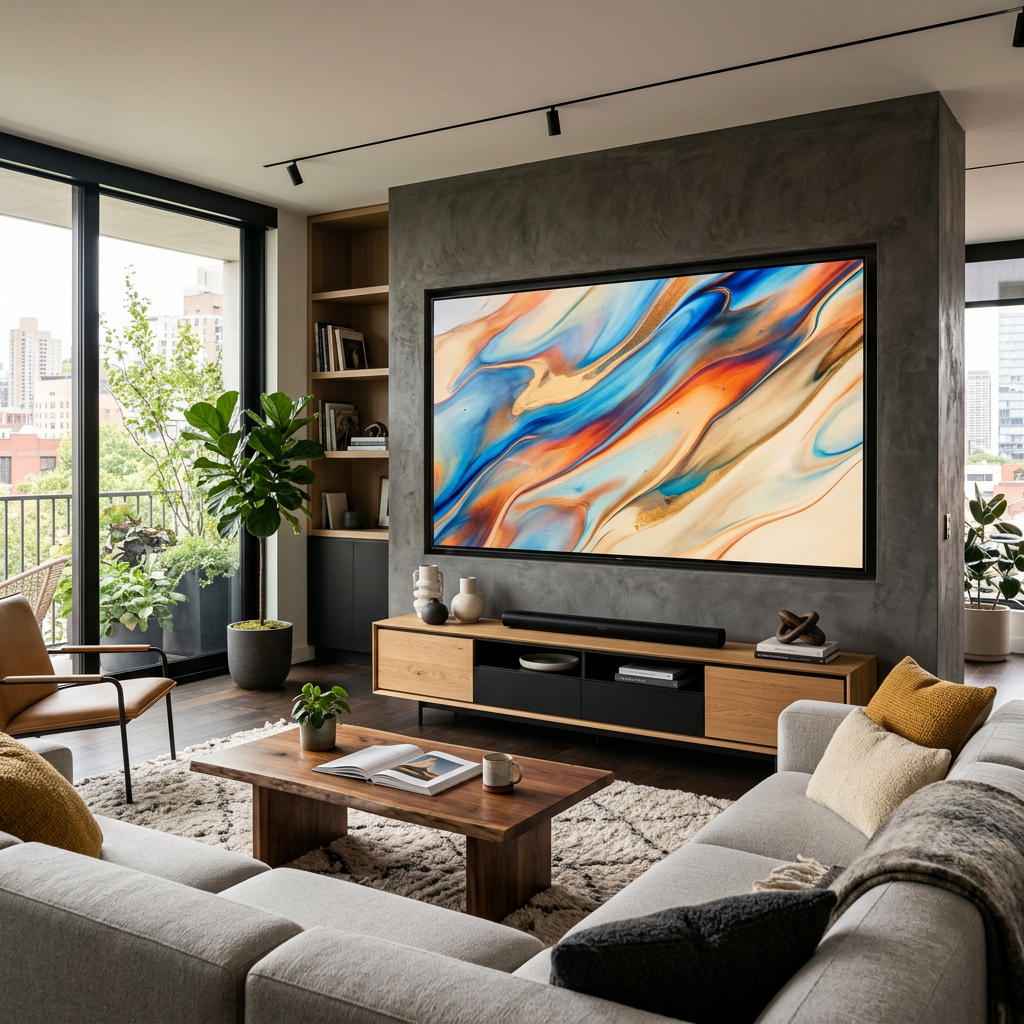
There was a time when buying a 60-inch television felt like a major luxury. A television that large could easily cost well over $1,000, and many families were perfectly happy with a 32-, 40-, or 50-inch screen. That has changed.

Today, 65-inch, 70-inch and 75-inch televisions are surprisingly affordable, and even larger screens are becoming accessible to the average household. With prices dropping and technology improving, many consumers are asking a very different question when they shop for a new television:
Why buy a smaller TV when I can get a much bigger one for only a little more money?
And honestly, it’s a good question.
The television has become one of the most important pieces of technology in the home. It isn’t just where we watch the news anymore. It’s where we stream movies, watch sports, play video games, watch YouTube, display family photos and spend time together.
So, is bigger really better? Sometimes—but size isn’t the only thing that matters.
Why Are Big-Screen TVs So Much Cheaper?
One of the biggest changes in the television market has been the dramatic reduction in the cost of large screens.
Manufacturers have become much more efficient at producing large 4K LED, QLED and Mini-LED televisions. At the same time, competition between brands has become fierce.
Companies such as TCL, Hisense, Samsung, LG and VIZIO are competing for consumers who want bigger screens without premium prices.
That competition is good for shoppers.
Features that once belonged primarily to expensive televisions—such as 4K resolution, HDR, QLED color technology, Mini-LED backlighting and advanced smart-TV platforms—are now available on much less expensive models.
As a result, a television that would have cost well over $1,000 years ago may now be available for several hundred dollars.
And when a 65-inch or even 75-inch television can be purchased for a few hundred dollars, it’s easy to understand why consumers are going bigger.
Why Does TV Size Matter?
Let’s be honest.
A bigger television feels different.
Watching a movie on a 75-inch screen isn’t the same experience as watching it on a 43-inch television.
The larger screen fills more of your field of vision, creating a more immersive experience. Movies feel more cinematic, sports are easier to follow and video games can feel more engaging.
But size can also make sense from a decorating perspective.
Many homes today have open-concept living rooms, great rooms and large entertainment walls. A small television can actually look lost on a large wall.
Think about it this way: A 55-inch television may have seemed enormous 10 years ago. Put that same television on a large wall in a modern great room, and suddenly it can look surprisingly small.
A larger screen can create a visual focal point while also making the room feel more like an entertainment space.
But Bigger Doesn’t Always Mean Better
Before you rush out to purchase the biggest television you can find, there’s an important detail to consider:
Your room matters.
A massive television sitting only a few feet away can be uncomfortable to watch.
You need to consider:
- The distance between your sofa and television
- The size of the wall
- The height of the television
- The layout of your furniture
- How much of your wall you want the TV to occupy
- Whether you’re mounting it or placing it on a console
For many homes, 65 inches is becoming a sweet spot.
It’s large enough to provide that big-screen experience without completely dominating a medium-sized living room.
If you have a larger family room or great room, however, 75 inches can be an incredible upgrade.
What About 75-Inch TVs?
This is where television shopping gets really interesting.
A 75-inch television used to be something you might find in a luxury home theater. Now, it’s becoming much more accessible.
Retailers are regularly offering 75-inch televisions from brands such as TCL, LG, VIZIO and Samsung for prices that would have been unthinkable several years ago.
And that changes the way consumers think about buying a television.
Instead of asking:
“Can I afford a big-screen TV?”
People are beginning to ask:
“How big can I go without overwhelming my room?”
That’s a major shift.

The Best Affordable Big-Screen TVs to Consider
Not every inexpensive television is a good deal. The goal isn’t simply to find the cheapest screen.
You want to find the best combination of price, size, picture quality, features and reliability.
Here are several affordable televisions worth considering.
TCL QM5 Series — Best Overall Budget Choice
If you’re looking for a television that gives you a lot for your money, TCL deserves serious consideration.
The TCL QM5 series combines 4K resolution with Mini-LED technology, which can provide better contrast and brightness than a basic LED television.
The 65-inch model is particularly interesting for shoppers who want a premium-looking television without spending premium money.
Where to shop:
Shop TCL 65-Inch QM5 at Target
TCL has also become a frequent favorite among budget-TV recommendations because of the amount of technology it packs into its lower-priced models.
Best for: Shoppers who want the best balance of size, features and price.
Hisense U6 Mini-LED — Best Affordable Picture Upgrade
If picture quality is more important to you, take a close look at the Hisense U6 series.
The U6 combines Mini-LED backlighting and QLED quantum-dot technology, giving it a significant advantage over many basic LED televisions.
Mini-LED technology allows manufacturers to use much smaller LEDs behind the screen, providing more precise control over bright and dark areas.
That can translate into better contrast and a more impressive picture.
Where to shop:
Shop Hisense 65-Inch U6 at Best Buy
Best for: Movie lovers and shoppers who want better picture technology without paying OLED prices.
Samsung Q6F QLED — Best Familiar Brand
Samsung has been a major name in televisions for years, and its QLED lineup gives shoppers another affordable option.
The Samsung Q6F combines QLED technology with 4K resolution and Samsung’s Tizen smart-TV platform.
It may not be Samsung’s premium television, but it offers a recognizable brand and a strong feature set at a much lower price point.
Where to shop:
Shop Samsung 65-Inch Q6F at Best Buy
Best for: Shoppers who prefer an established brand and want QLED technology without moving into Samsung’s premium price range.
LG UA75 70-Inch — Best for Going Bigger
Sometimes you aren’t looking for the absolute best picture.
Sometimes you just want a BIG TV.
The LG UA75 is worth considering if you’re ready to move beyond 65 inches while keeping the price relatively reasonable.
The 70-inch model offers 4K resolution and LG’s webOS smart-TV platform.
Where to shop:
Shop LG 70-Inch UA75 at Walmart
If you really want to go big, LG also offers a 75-inch version.
Where to shop:
Shop LG 75-Inch UA75 at Walmart
Best for: Large living rooms where a 65-inch television might feel too small.
VIZIO 75-Inch Quantum — Best for Maximum Screen Size
If your number-one priority is getting the most screen for your money, VIZIO is worth a look.
The VIZIO 75-inch Quantum combines a huge screen with QLED technology and 4K resolution.
Where to shop:
Shop VIZIO 75-Inch Quantum at Walmart
A 75-inch television can completely change the appearance of a living room. Instead of simply being another electronic device, it can become the room’s main focal point.
Best for: Large rooms, sports fans, movie lovers and anyone who wants a true home-theater feeling.
What Should You Look for When Buying a Cheap TV?
Cheap doesn’t necessarily mean bad.
But there is a difference between finding an affordable television and simply buying the cheapest television available.
Before purchasing, pay attention to the following:
1. Screen Size
Don’t automatically choose the largest TV.
Think about your room and viewing distance first.
2. Resolution
For a modern television, 4K should be the standard you’re looking for if your budget allows.
3. QLED
QLED can provide richer colors and greater brightness than many basic LED televisions.
4. Mini-LED
If you can find Mini-LED technology at a reasonable price, it’s worth considering. It can provide better contrast and more precise backlighting.
5. HDR
High Dynamic Range can improve the difference between bright and dark areas of the picture, making movies and shows look more realistic.
6. Smart-TV Platform
Consider whether you prefer Roku, Google TV, Fire TV, Samsung’s Tizen or LG’s webOS.
Your smart-TV platform will determine how you access streaming services and other apps.
7. HDMI Ports
This is easy to overlook.
If you have a gaming console, soundbar, streaming device and other equipment, you’ll want enough HDMI connections.
65 Inches vs. 75 Inches: Which Should You Buy?
If you’re stuck between the two, think about your room.
Choose 65 inches if:
You have a medium-sized living room.
Your sofa isn’t particularly far from the television.
You want a large screen without making the television the only thing you see.
You want the best balance between price and size.
Choose 75 inches if:
You have a large living room or great room.
Your seating is farther away from the television.
You watch a lot of movies or sports.
You want a home-theater feeling.
You have a large entertainment wall that needs a focal point.
Don’t Forget the Television Stand
There’s another decorating consideration that often gets overlooked.
Your television doesn’t exist by itself.
If you’re purchasing a 75-inch television, make sure your entertainment console is wide enough and sturdy enough to support it.
You also want the console and television to look proportionate.
A huge television sitting on a tiny console can make the entire room feel visually unbalanced.
And if you’re mounting the television, think about what will surround it.
Lighting, artwork, shelving and decorative accessories can keep the wall from feeling like nothing more than a giant black rectangle.
Are Big-Screen TVs the Future?
It certainly appears that consumers are becoming more comfortable with larger screens.
As technology improves and manufacturing becomes more efficient, the price gap between smaller and larger televisions continues to shrink.
That means the 65-inch television that once felt enormous may eventually become the standard size for many living rooms.
And 75 inches?
It may eventually become what 55 inches is today: large, but completely normal.

My Picks for Affordable Big-Screen TVs
If I were shopping for a new budget-friendly television today, these would be the categories I’d consider:
Best overall value: TCL QM5 Series
Best affordable picture upgrade: Hisense U6 Mini-LED
Best recognizable brand: Samsung Q6F QLED
Best 70-inch option: LG UA75
Best for maximum screen size: VIZIO 75-Inch Quantum
The best part is that you don’t necessarily have to spend $1,000 or more to get an impressive big-screen television.
So, Is Bigger Really Better?
The answer is yes—but only if bigger makes sense for your home.
A 75-inch television isn’t automatically better than a 65-inch television. A $400 television isn’t automatically better than a $700 television.
What matters is finding the right combination of screen size, picture quality, technology and price.
But there’s no denying that the television-buying game has changed.
Large screens are no longer reserved for luxury homes or dedicated theaters. They’re becoming part of everyday living rooms.
And when you can walk into a store or shop online and find a 65-, 70- or 75-inch 4K smart TV for several hundred dollars, it’s easy to see why so many people are choosing to go bigger.
Maybe the real question isn’t whether big-screen TVs are the future.
Maybe it’s simply:
How big is too big for your living room?
Prices and availability change frequently, particularly during major sales events. Always check the retailer’s current price, specifications and return policy before purchasing.




Leave a Reply