
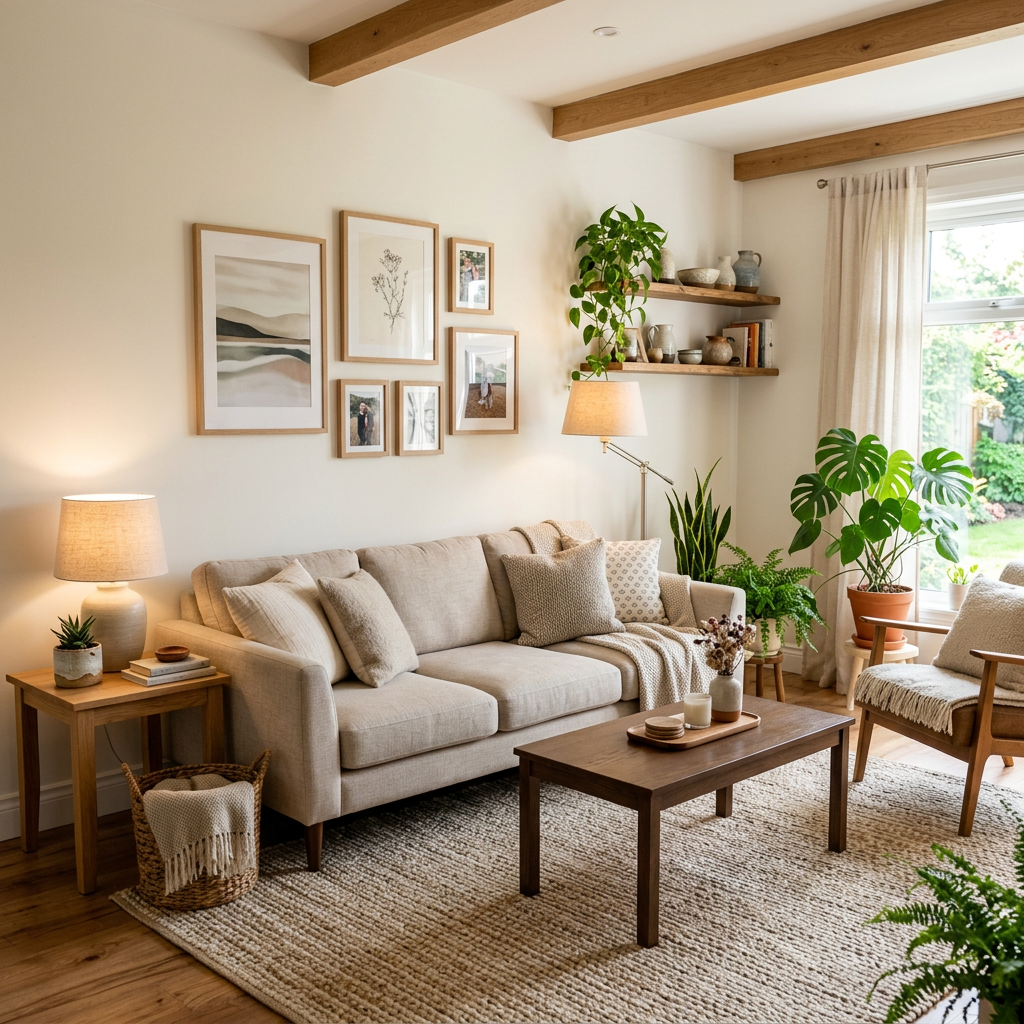
You have the keys. You have the room. Now what according to the first room decorating guide? On the other hand, decorating comes naturally to some people. Also, they can walk into an empty room and picture the sofa, the rug, and where everything should go. Then there are those of us who walk into an empty room and think, “Where in the world do I even start?”

If you are decorating your first home, apartment, condo, or rental, the process can feel overwhelming. As a result, there are thousands of paint colors, countless furniture styles, and rug, lighting, artwork, curtain, and accessory choices. Before long, what was supposed to be exciting can begin to feel like a very expensive guessing game.

But here’s the good news: you don’t have to be an interior designer to learn how to decorate.
Indeed, decorating is a skill. For example, a practical first room decorating guide helps you learn basic principles and tailor decisions to your space. You do not need to have everything figured out before you begin. You simply need to know where to start.
Start With the Room, Not the Shopping Cart
One of the biggest mistakes a first-time decorator can make is buying things before understanding the room. Consequently, you may see a beautiful sofa online or in-store and quickly fall in love with something. The problem comes when you bring it home and discover that it is too large, too small, or simply doesn’t work with the way your room is arranged.
Before purchasing anything, take some time to study your space. Next, measure the room’s length and width, and note ceiling height, windows, doors, outlets, and vents. As a result, anticipate foot traffic paths in the room and ensure furniture does not impede them.
For example, a simple floor plan can be incredibly helpful. You don’t need special software or professional drafting skills. A piece of paper and a pencil can be enough. You can even use painter’s tape on the floor to outline the dimensions of a sofa, bed or dining table before purchasing it. This simple trick can help you visualize how much space a piece of furniture will actually occupy.
Professional designers pay close attention to scale and proportion, which essentially means making sure the size of furniture and décor relates appropriately to the room and to the other objects around it. A piece that looks beautiful in a large showroom may feel completely overwhelming in a small apartment. Houzz: 5 Decorating Tips for Getting Scale Right
Before You Choose a Style, Decide How You Live
Before worrying about whether your room should be modern, farmhouse, traditional, boho or contemporary, think about how you actually use the space.
A living room may look beautiful in a photograph with a delicate white sofa and a collection of decorative objects, but if you have children, pets or a large family that spends most evenings watching movies together, your decorating choices may need to be different.
Your home should support your lifestyle. Think about what happens in the room on an ordinary day. Is your living room primarily for entertaining, relaxing, watching television or spending time with family? Does your bedroom need to accommodate a workspace? Does your dining room need to function as a homework station or home office?
These questions may not sound like decorating questions, but they are some of the most important ones you can ask. Function should come before decoration. Once you know how you will use the room, choosing furniture and décor becomes much easier.
Discover Your Decorating Style
You don’t have to know the official name of your decorating style before you begin. In fact, trying to force yourself into one particular style can sometimes make decorating more difficult.
Instead, start collecting pictures of rooms you love. Look through Pinterest, magazines, home décor websites or social media and save anything that catches your attention. Don’t worry about whether the rooms look completely different from one another.
After you’ve collected several images, look for patterns.
Maybe you keep choosing rooms with warm wood tones. Perhaps you repeatedly save rooms with neutral walls and colorful artwork. Maybe you love black accents, vintage furniture, natural materials or lots of greenery.
Those patterns are clues to your personal style.
And don’t be afraid to mix styles. A modern sofa can work beautifully with a vintage coffee table. A traditional bedroom can have contemporary artwork. A farmhouse-inspired room can incorporate metal lighting and modern accessories.
Your home doesn’t have to look like a furniture showroom where everything came from the same collection. Mixing materials, periods and styles can give a room personality and make it feel collected rather than manufactured.

Choosing Colors Without Getting Overwhelmed
Color is one of the areas where first-time decorators often become stuck. There are simply too many choices.
Instead of trying to choose ten colors, start with a simple palette. Think about selecting a dominant color, a secondary color and an accent color. The commonly used 60-30-10 rule can be a helpful starting point: approximately 60 percent of the room is your dominant color, 30 percent is a secondary color and 10 percent is an accent.
You don’t have to literally calculate percentages throughout your room. Think of it more as a guideline for maintaining balance. Sherwin-Williams describes the 60-30-10 approach as a useful starting point for building a cohesive color palette. Sherwin-Williams Color Guidance
And here’s an important decorating tip: don’t automatically choose your paint color first.
If you already own a sofa, rug, piece of artwork or another major item that you absolutely love, consider pulling your wall color from that piece. There are thousands of paint colors available, making it easier to find paint that works with your furniture than to find furniture that perfectly matches a paint color you already selected.
Always test paint colors in your actual room when possible. Natural light, artificial light and the surrounding colors can change how a paint color appears throughout the day.
Choose Your Major Furniture Before the Little Things
Once you understand the room and have an idea of your color palette, it’s time to think about your larger furniture pieces.
A sofa in the living room could be yours. The bed may be the centerpiece in the bedroom. The dining table might act as the room’s focal point.
These larger pieces establish the foundation of the room.
Think about decorating like getting dressed. You wouldn’t necessarily begin by choosing your earrings and then attempt to build an entire outfit around them. You generally start with the major pieces and add accessories afterward.
Your room works much the same way. Choose the major furniture first, then build the personality of the room around it.
Don’t Underestimate the Power of a Rug
A rug is more than something that covers the floor. It can actually help define a room. In a living room, a properly sized rug can visually connect your sofa, chairs and coffee table, making the seating area feel like one intentional arrangement. A rug that is too small can make the furniture appear disconnected, almost as if each piece is floating independently.
Before purchasing a rug, measure the area you want it to cover and consider how the furniture will sit around it. The goal isn’t simply to find a rug that fits somewhere in the room. The goal is to find one that works with the furniture arrangement. This is another place where scale matters.
Learn to See Scale and Proportion
If you’re going to learn one professional decorating term, make it scale. Scale is essentially the relationship between the size of an object and the space around it. Imagine placing a tiny coffee table in front of a large sectional sofa. Something immediately feels off. Now imagine a massive coffee table surrounded by tiny chairs. The same problem occurs.
The individual pieces may be attractive, but they don’t relate properly to one another. The same principle applies to artwork. A tiny picture hanging alone on a huge wall may disappear. A large piece of artwork can sometimes create much more impact.
Learning to recognize scale will dramatically improve your decorating decisions because you’ll begin thinking about how pieces relate to one another instead of simply asking whether you like each item individually.
Give Your Room Room to Breathe
Another common beginner mistake is believing that every empty space needs something. It doesn’t. Not every corner needs to be filled with furniture. Artwork on every wall isn’t necessary. Only some shelves should feature decorative objects.
Empty space is part of good design.
Negative space allows the eye to rest and helps important furniture and décor stand out. Overcrowding a room can make even a large space feel small.
Before buying something simply because you have an empty corner, live with the room for a while. You may discover that the empty space actually makes the room feel better.
As Houzz notes in its decorating guidance, allowing furniture and important elements adequate breathing room can help prevent a room from feeling overcrowded. Houzz: Decorating Tips to Make Any Room Better
Lighting Can Completely Change a Room
One of the easiest ways to make a room feel more thoughtfully designed is to stop relying on one overhead light. Think about lighting in layers.
Your overhead fixture provides general illumination, but table lamps, floor lamps and accent lighting can create warmth and atmosphere. A lamp beside a reading chair can make that area feel intentional. A table lamp on a console can create a soft glow in the evening. Accent lighting can draw attention to artwork or architectural details.
This approach is often described as layered lighting, using ambient, task and accent lighting to serve different purposes. The result isn’t simply a brighter room. It’s a room that can change depending on the time of day and what you’re doing.
Try turning off your overhead light one evening and using your lamps instead. You may be surprised at how much more comfortable the room feels.
Texture Is Just as Important as Color
Here’s another secret that can completely change a beginner’s approach to decorating: a room doesn’t always need more color. Sometimes it needs more texture.
Imagine a neutral room containing a wood coffee table, woven rug, linen curtains, leather sofa, ceramic vase and soft throw blanket. The colors may be relatively simple, but the room can still feel rich and interesting because of the variety of materials. Try mixing wood, metal, glass, ceramic, woven materials and different fabrics.
This is also why you don’t have to choose between wood and metal when decorating. The two can work beautifully together. A wood table with metal legs, a brass lamp beside a wooden nightstand or a metal-framed mirror above a wood console can create contrast without making the room feel mismatched.
The secret isn’t making everything identical. It’s creating relationships between the materials.
Let Your Walls Tell Your Story
A new home can feel unfinished when the walls are completely bare, but that doesn’t mean you need to rush out and buy artwork for every room. Start with something meaningful.
A family photograph might be what it is. It could be artwork you purchased on vacation. Maybe it’s a vintage piece you found at a thrift store. Maybe it’s something you created yourself. Your walls are an opportunity to tell your story.
Don’t decorate simply because a wall is empty. Decorate because you found something worth displaying. And if you have a large wall, don’t automatically assume that several tiny pieces will solve the problem. Sometimes one substantial piece of artwork or a thoughtfully arranged gallery wall can create much more visual impact.
Accessories Come Last
Once your furniture, rug, lighting and major design elements are established, you can begin adding accessories. This is where you can have fun. Bring in pillows, throws, books, plants, vases, baskets, candles, decorative objects and smaller pieces of artwork. These are the elements that can make a room feel personal. But resist the urge to buy everything at once. Decorate, step back and look at the room. Then decide what it actually needs.
Perhaps it needs more color. A plant might be needed. A second light may be needed. No further elements seem necessary. Sometimes the best decorating decision is knowing when to stop.
Don’t Try to Finish Your Entire Home in One Weekend
This may be the most important advice for a first-time homeowner or renter. Give yourself time. When you move into a new home, it can be tempting to immediately purchase everything you think you need. You want the perfect sofa, curtains, dining set, bedroom furniture, artwork and accessories. But your home doesn’t have to be finished immediately.
In fact, some of the most personal homes are those that develop gradually. Here you may discover a piece you love. There, you inherit something. Locally, you may discover a great artwork at a shop. The color palette may undergo changes again six months down the line. That’s normal. Your decorating style can evolve as you learn more about yourself and your home.
Decorating on a Budget
If you’re decorating your first home on a limited budget, don’t assume you have to buy everything new. Look at what you already own.
Might an old dresser become a television console? Is it possible for a chair to move from one room to another? Would updating the hardware on an existing piece give it a completely different appearance? Could a mirror be painted? Could family photographs become a gallery wall? Decorating doesn’t always require spending more money. Sometimes it requires looking at what you already have differently.
If you are renting, there are also plenty of ways to personalize a space without making permanent changes. Area rugs, curtains, lamps, removable wallpaper, artwork, decorative mirrors, pillows and furniture can dramatically change a room without requiring major renovations.
The Room Doesn’t Have to Look Like Everyone Else’s
One of the biggest traps in decorating today is comparison. You see beautiful rooms online and begin believing your home should look exactly like them. But photographs don’t show you everything.
This text does not illustrate how comfortable the furniture is. This piece does not show whether the room works for a family. They don’t show the homeowner’s budget. They don’t show how the room looks at 7 p.m. when the lights are on and everyone is actually living in it.
Your home should work for your life. Bold colors appeal to you when neutral rooms are popular. You may love traditional furniture while everyone else is talking about modern design. Maybe you want a colorful bedroom or a simple living room. That’s okay. Trends can provide inspiration, but they don’t have to determine how you live.
Your Simple Decorating Formula
If you’re completely overwhelmed, remember this: Measure the room. Determine how you use the space. Find inspiration. Discover what styles and colors you naturally gravitate toward.
Choose your major furniture pieces. Add a properly scaled rug. Layer your lighting. Introduce texture. Add artwork and accessories. Then stop and live in the room. You don’t have to make every decision on day one.

Your First Room Is a Learning Experience
Decorating your first room can feel intimidating because you’re making decisions you may never have had to make before. But don’t let the fear of getting something wrong prevent you from getting started. Some mistakes may occur.
It’s possible to buy a pillow you eventually dislike. Moving the sofa three times is allowed. You may discover that the paint color you loved in the store looks completely different on your wall. You may buy a rug that isn’t quite large enough. That’s part of learning. The goal isn’t perfection. The goal is learning how to look at a room and understand what it needs.
Start small. Pay attention to scale. Think about function. Experiment with color. Mix textures. Use lighting intentionally. Give yourself permission to change your mind.
And most importantly, remember that your home doesn’t have to look like a magazine. It should look like you. Because the real goal of decorating isn’t simply creating a beautiful room.
It’s creating a place where you walk through the door and feel at home.
Sources & Further Reading
Houzz — Decorating Tips: Guidance on scale, proportion, furniture placement, visual balance and creating cohesive rooms.
Houzz Decorating Tips
Houzz — Scale & Proportion: Professional guidance on selecting appropriately sized furniture and décor for a room.



Leave a Reply