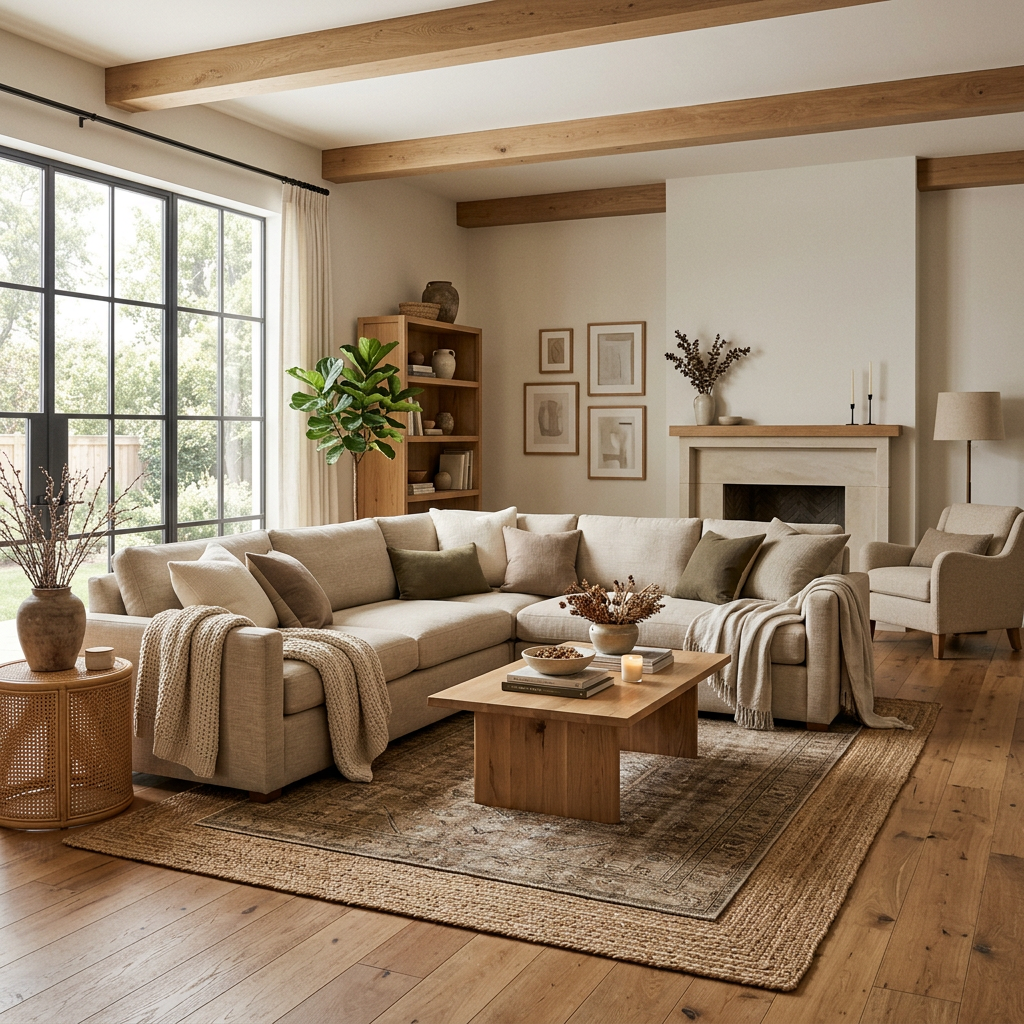
Selecting the right sectional enhances appeal and balances size, layout, and comfort from compact to open-plan rooms. It says, come sit down, get comfortable, and stay awhile. A sectional can fit irregular layouts, create cozy corners, and define zones in a large living area. Whether you are creating a cozy family room, designing a stylish apartment, or furnishing a spacious open-concept space, it offers seating and a natural centerpiece for the room.

But there is one problem: not every sectional is right for every space.

Before you fall in love with that oversized cream sectional you saw online, you need to think about your room, your lifestyle, and—most importantly—your measurements. So how do you choose the right sectional for your home? Let’s break it down.
Start With Your Space—Not the Sofa
The biggest mistake people make when shopping for a sectional is shopping based on appearance first.
We see a beautiful living room online, imagine that same sofa in our house, and start looking for something similar. Then the sectional arrives and suddenly the room feels smaller, the walkway is blocked, or the chaise is sitting exactly where you didn’t want it. Instead, start with your room.
Measure the wall where you plan to place the sectional. Then measure the depth of the room and the surrounding walkways. Don’t forget to measure doorways, hallways, stairways, and tight corners the furniture will have to travel through.
A good rule of thumb is to preserve roughly 30–36 inches for major walking paths. You should also leave enough breathing room between the sectional and your coffee table so the room doesn’t feel cramped.
And here’s a trick I absolutely recommend: use painter’s tape to mark the sectional’s footprint on your floor. If the tape outline makes the room feel crowded, the actual sectional probably will too.
Understanding the Different Types of Sectionals
Once you know how much space you have, it’s time to decide what type of sectional makes sense for your room.
1. The L-Shaped Sectional
The L-shaped sectional is probably the most versatile option.
It has a longer sofa section and a shorter section that creates the “L.” This design works particularly well in corners and medium-sized living rooms. It can also help define a living area in an open-concept home without completely closing off the space.
Best for:
- Small-to-medium living rooms
- Corner placement
- Families
- Open-concept homes
- TV rooms
If you’re not sure what type of sectional to buy, an L-shaped design is usually a great place to start.
2. The Sofa + Chaise Sectional
A chaise sectional is perfect for the person who loves to stretch out.
Instead of having seating that extends around the corner, one side becomes a long chaise. This gives you that “put your feet up” feeling without taking up as much room as a large U-shaped sectional.
It is especially useful when you have a long wall but don’t have enough room for seating on three sides.
Best for:
- Apartments
- Smaller living rooms
- Movie nights
- Relaxing and lounging
- Single-wall layouts
And if you’re unsure which side the chaise should be on, look for a reversible chaise.
That little feature can save you a lot of frustration later.
3. The U-Shaped Sectional
Now we’re talking about serious seating.
A U-shaped sectional creates a seating area on three sides and is designed for larger spaces. It’s great for families, entertaining, game nights, and homes where the living room is a major gathering space.
But don’t force one into a small room.
A U-shaped sectional can quickly overwhelm a smaller living room and make the space difficult to navigate.
Best for:
- Large family rooms
- Large open-concept spaces
- Home theaters
- Families who entertain
- Large households
Think of a U-shaped sectional as furniture that needs room to breathe.
4. The Modular Sectional
If you like flexibility, take a serious look at modular sectionals.
Modular sectionals are made from individual pieces that can often be rearranged. Depending on the design, you may be able to create an L-shape, U-shape, traditional sofa, or separate seating arrangements.
This is particularly useful if you move frequently, like changing your furniture layout, or aren’t completely sure how you want your room configured.
Best for:
- People who like to rearrange
- Growing families
- Open floor plans
- Multi-purpose rooms
- People who may move in the future
The biggest advantage? Your sectional can change with your home.

Don’t Forget About Left-Facing vs. Right-Facing
This one confuses a lot of shoppers.
When a sectional is described as left-facing or right-facing, the orientation is generally determined by looking at the sectional from the front.
So don’t assume “left-facing” means the chaise will be on your left when you’re sitting on the couch.
Always look at the retailer’s diagram before ordering.
If your room layout isn’t permanent, a reversible chaise or modular sectional may be a much safer choice.
Think About How You Actually Live
A beautiful sectional isn’t necessarily a functional sectional. Ask yourself: Do you have children?
Look for durable, easy-care upholstery. Do you have pets? Consider performance fabrics, washable covers, or upholstery that is relatively easy to clean.
Do you entertain often? Prioritize seating capacity.
Do you love movie nights? A deeper chaise or oversized sectional may be perfect.
Do you host overnight guests? Consider a sleeper sectional.
Do you constantly rearrange your furniture? A modular or reversible design could be worth the investment. The best sectional isn’t necessarily the most expensive one. It’s the one that fits the way you actually live.
What About Comfort?
This is where shopping online can become tricky. A sectional may look beautiful in a photograph but feel completely different once you sit on it.
Pay attention to:
- Seat depth
- Seat height
- Cushion firmness
- Back support
- Arm height
- Cushion construction
- Upholstery
- Frame construction
If you prefer sitting upright, don’t automatically choose an extremely deep “cloud-style” sectional just because it is trendy. If your favorite thing to do is curl up with a blanket and watch television, however, a deeper sectional might be exactly what you need.
Your body should help choose your sofa—not just your Pinterest board.
Sectional Recommendations to Consider
Here are several options worth looking at while shopping.
Best Budget-Friendly Small-Space Option
This is a particularly practical option for smaller homes because it combines a sectional, chaise, sleeper, and storage. At the time of research, it was listed around $670 on sale and measures approximately 84 inches wide.
Why I like it: You’re getting multiple functions from one piece of furniture.
Best for a Flexible Layout
The Paige is a good choice if you want something more polished while still having the flexibility of a reversible configuration. It is approximately 87 inches wide and was listed around $1,839 on sale when researched.
Why I like it: It offers a more tailored look without committing to a large permanent sectional configuration.
Best Mid-Range Modular Option
This option combines an L-shaped configuration with modular functionality and sleeper capability. It was listed around $870 on sale at the time of research.
Why I like it: It gives you flexibility without jumping immediately into luxury-sectional pricing.
Best for a Larger Living Room
If you have a large room and want your sectional to become the centerpiece, a U-shaped design like this one can create a substantial conversation and lounging area. The Harmony U-shape shown here is approximately 153 inches wide, so this is definitely a measure-first purchase.
Why I like it: It creates a dedicated seating zone and works particularly well in large open spaces.
Best for a More Traditional L-Shaped Look
For someone who wants a substantial L-shaped sectional without moving into a U-shaped configuration, this is a good example of how a larger sectional can anchor a living room.
The configuration shown is approximately 128 inches wide.
Why I like it: It gives you generous seating while maintaining a classic L-shaped layout.

Don’t Forget the Rug
One of my favorite ways to make a sectional look intentional rather than simply “placed in a room” is to anchor it with an area rug. Ideally, the rug should be large enough for at least the front legs of your seating to sit on it. This visually connects the sectional, coffee table, and accent furniture into one conversation area.
And don’t be afraid to use contrast. A neutral sectional can look amazing with a patterned rug. A darker sectional can work beautifully with a lighter rug. And if your sectional already has a bold color, consider keeping the rug more understated.
What Color Sectional Should You Choose?
If you’re investing in a sectional that you expect to keep for several years, I would think carefully before choosing an extremely trendy color.
Neutral colors such as:
- Cream
- Beige
- Taupe
- Gray
- Greige
- Brown
- Charcoal
give you much more flexibility when decorating.
You can change your pillows, blankets, artwork, curtains, and accessories without having to replace the entire sofa.
That doesn’t mean your sectional has to be boring.
You can add personality with texture.
Think boucle, chenille, linen-look fabrics, velvet, leather, or textured performance fabrics.
Should You Buy a Sectional or a Regular Sofa?
This really comes down to your room and lifestyle.
A sectional may be the better choice if you:
- Need more seating
- Have an open floor plan
- Want a dedicated lounging area
- Enjoy entertaining
- Have a large family
- Want a built-in chaise
A traditional sofa may be better if:
- Your room is narrow
- You frequently rearrange furniture
- You have several doorways or windows
- You live in a smaller apartment
- You want maximum flexibility
And if you’re somewhere in between, a modular sectional might give you the best of both worlds.
Before You Click “Buy,” Ask Yourself These 7 Questions
Before purchasing your sectional, make sure you can answer:
1. Does it physically fit my room?
2. Can I comfortably walk around it?
3. Will it fit through my doors and hallways?
4. Is the chaise on the correct side?
5. Is the upholstery practical for my household?
6. Is the seat comfortable for the way I actually use my sofa?
7. Will I still like the design several years from now?
If you can answer yes to all seven, you may have found your sectional.

The Bottom Line
However, a sectional should make your living room feel more comfortable, not crowded. Before you worry about the color, style, or whether the sofa is trending, figure out how much space you actually have and how you want to use it. If the room is small, consider a compact chaise or L-shaped sectional. Consequently, a chaise or L-shaped sectional can fit comfortably in compact rooms. If you have a medium room, an L-shaped sectional can supply comfortable seating without overwhelming the space. In addition, an L-shaped sectional offers plenty of seating without making the space feel crowded.
When you have a large room, a U-shaped or oversized modular sectional may be exactly what you need. Indeed, a U-shaped or oversized modular sectional may be exactly what you need. To clarify your future layout, go modular or choose a reversible chaise. Go modular or choose a reversible chaise.
And remember: the best sectional isn’t the biggest sectional you can fit into your room. It’s the one that fits your space, your lifestyle, and your vision for your home.
After all, your living room should be a place where you want to live—not a place where you’re constantly trying to walk around the furniture.


Leave a Reply