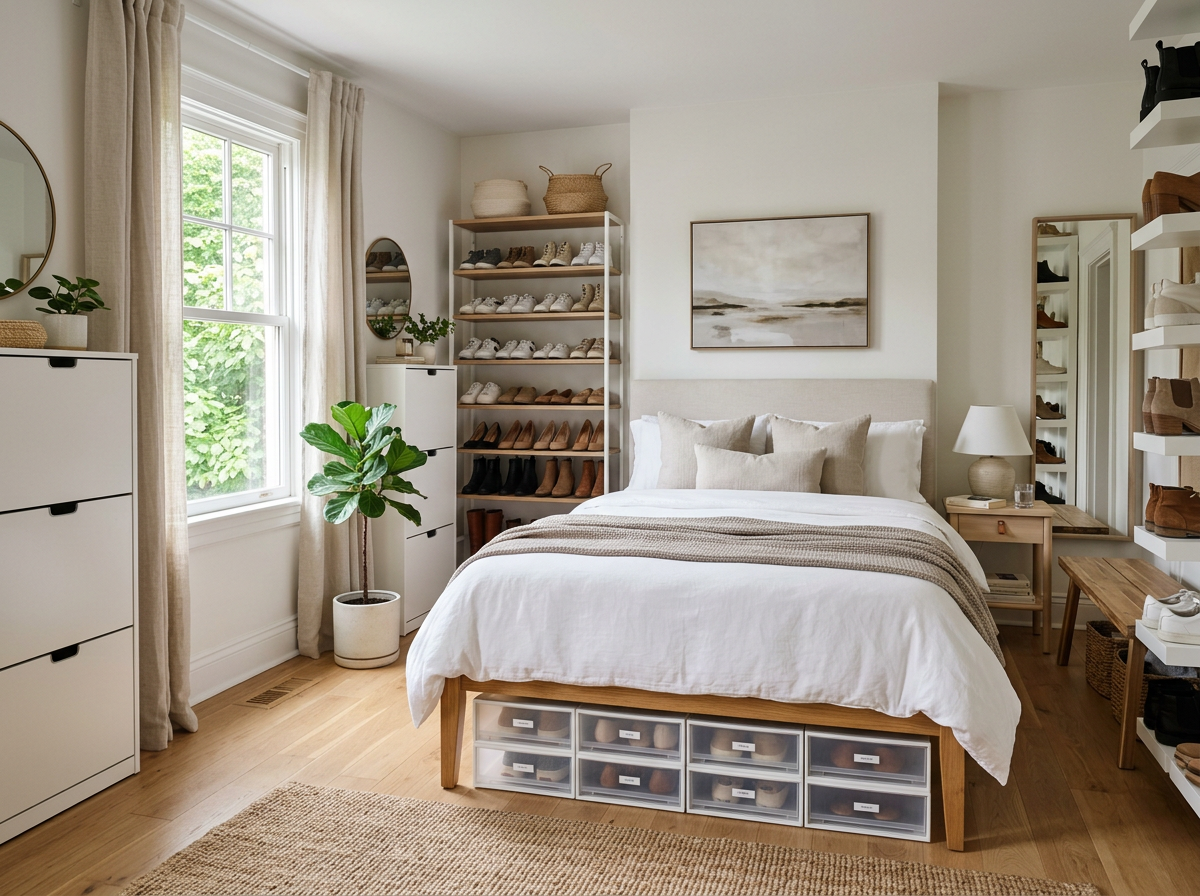
Learn how to organize your shoe collection and maximize space.
Too Many Shoes, Not Enough Space? Creative Shoe Storage Ideas for Small Homes. Let’s be honest: some of us love shoes more than our closets have room. From sneakers to boots, collecting pairs can become a storage challenge. Before you know it, the closet overflows and shoes line the front door.

Sound familiar? Having a large shoe collection doesn’t mean your home has to look cluttered. You don’t necessarily need a bigger closet, an expensive organization system, or an entire room dedicated to your shoes. If you’re someone who loves shoes but doesn’t have the storage space to accommodate your collection, here are some creative ways to make it work.

1. Look Beyond Your Closet
One of the biggest mistakes people make when organizing shoes is assuming that every pair needs to live inside the bedroom closet. Your closet may be the most convenient location, but it isn’t necessarily the only option.
Think about some of the unused spaces throughout your home:
- Underneath your bed.
- Behind your bedroom door.
- Inside an entryway cabinet.
- Along an empty hallway wall.
- Under a staircase.
- Inside an unused corner of your bedroom.
These areas can become valuable storage opportunities when you use them intentionally. For example, a narrow shoe cabinet against an empty hallway wall can hold several pairs without taking up much floor space. An under-bed storage organizer can accommodate shoes you don’t wear every day. The goal is to stop looking at shoe storage as something that belongs exclusively in your closet.
2. Take Advantage of Vertical Space
When floor space is limited, start thinking vertically. Your walls may have more storage potential than you realize. Instead of purchasing another bulky shoe rack, consider using your available wall space.
Here are a few ideas:
- Wall-mounted shoe shelves: Install narrow floating shelves to display your favorite shoes.
- Over-the-door organizers: Use pockets or hanging racks to store flats, sandals, sneakers, and other lightweight shoes.
- Tall shoe cabinets: Choose a slim cabinet that takes advantage of vertical space rather than extending across your floor.
- Adjustable shelving: Create a customized storage area that accommodates different shoe heights.
Vertical storage is especially helpful in apartments, smaller bedrooms, and homes without walk-in closets. You can even make your shoe storage part of your bedroom decor. A well-organized display of beautiful shoes can become a decorative feature rather than something you feel the need to hide.
3. Make Your Bed Work for You
Have you ever considered how much unused space is underneath your bed? For people with limited closet space, this can be one of the most practical storage solutions available. Under-bed shoe organizers come in different sizes and styles. Some have individual compartments, while others feature clear zippered covers that allow you to see what’s inside.
Consider these options:
- Flat rolling storage drawers.
- Fabric shoe organizers with dividers.
- Clear under-bed storage containers.
- Stackable boxes designed for low-clearance spaces.
This is an excellent place to store seasonal shoes, special occasion heels, sandals, and shoes you don’t wear regularly.
Design tip: Choose storage containers that coordinate with your bedroom colors. Even though they’re hidden, keeping your storage organized makes it easier to maintain your space.
4. Turn an Entryway Into a Shoe Storage Station
If your shoes tend to accumulate near the front door, why not create a designated space for them? An entryway shoe station can help prevent clutter from spreading throughout your home. You don’t need a large mudroom to make this happen. A small bench with built-in shoe storage can provide seating and organization in one piece of furniture.
Other options include:
- A narrow shoe cabinet with concealed compartments.
- A storage bench with baskets underneath.
- A small chubby organizer.
- A decorative console table with storage baskets.
- A vertical shoe rack tucked beside the door.
The trick is to keep everyday shoes accessible while storing the rest of your collection somewhere else.
You might also consider limiting the entryway to the shoes you wear most frequently. This keeps your entrance from becoming an extension of your entire shoe collection.

5. Use Clear Shoe Boxes to Maximize Organization
If you love being able to see every pair of shoes you own, clear shoe boxes might be exactly what you need. Unlike traditional shoe boxes, clear containers allow you to identify your shoes without opening multiple boxes. They also create a uniform appearance, which can make even a large collection look organized.
You can:
- Stack clear boxes vertically.
- Label boxes by shoe type.
- Arrange shoes by color.
- Separate everyday shoes from special occasion shoes.
- Use drop-front boxes for easier access.
One important consideration is ventilation. Make sure your shoes are completely dry before storing them, and avoid sealing damp or sweaty footwear in airtight containers. For expensive or delicate shoes, consider appropriate shoe trees or protective storage bags.
6. Give Your Furniture a Second Purpose
Sometimes the best storage solutions aren’t marketed as shoe storage at all. Look around your home and consider whether some of your existing furniture could serve more than one purpose. For example:
Storage ottomans: These can hold sandals, flats, slippers, and other shoes while providing additional seating.
Bedroom storage benches: Place one at the foot of your bed and use the interior for shoes you don’t wear daily.
Bookcases: Adjustable shelves can easily accommodate sneakers, heels, and flats. Add decorative baskets to conceal shoes you don’t want on display.
Wardrobes: If your bedroom closet is small, a separate wardrobe with shelves can provide additional shoe storage.
Cabinets: Repurpose a cabinet with adjustable shelving to create a dedicated shoe storage area.
Multifunctional furniture is particularly useful in smaller homes because it allows one piece of furniture to serve several purposes.
7. Don’t Forget Those Awkward Spaces
Every home has those little spaces that seem too small to do anything with. However, some of them can be surprisingly useful for shoe storage. Think about the narrow space between your dresser and wall, the area behind a bedroom door, or that small corner next to your closet.
A few creative solutions include:
- Narrow rolling shoe carts.
- Slim pull-out shoe organizers.
- Corner shelving.
- Hanging shoe racks.
- Custom-built narrow shelving.
Even a space that is only several inches wide might accommodate a few pairs of flats or sandals.
Before purchasing anything, measure your available space. Pay attention to the depth, width, and height so you don’t end up with another storage item that doesn’t fit.

8. Organize Your Shoes by How Often You Wear Them
One of the easiest ways to make a large shoe collection more manageable is to organize it according to how frequently you use each pair. Not every pair needs to be equally accessible. Try dividing your shoes into three categories:
Everyday shoes: Sneakers, flats, work shoes, and other footwear you wear regularly. Keep these within easy reach.
Occasional shoes: Heels, dress shoes, special occasion footwear, and shoes you wear less frequently. Store these on higher shelves or in labeled containers.
Seasonal shoes: Winter boots, summer sandals, and other footwear that you only need during certain times of the year. Store these in under-bed containers or other less accessible areas.
This simple system prevents you from constantly moving shoes around just to find the pair you want.
9. Create a Shoe Display That Doubles as Decor
Who says shoe storage has to be boring? If you have beautiful shoes, designer sneakers, or a collection of heels that you’re particularly proud of, consider turning some of them into part of your decor. A few floating shelves, a small display bookcase, or a dedicated shoe wall can create an attractive feature in your bedroom or dressing area.
For a more polished look:
- Arrange shoes by color.
- Use matching shelves.
- Keep the display from becoming overcrowded.
- Incorporate subtle lighting.
- Mix in a few decorative accessories.
Think boutique dressing room rather than crowded shoe closet.
However, be mindful of direct sunlight, dust, and humidity, particularly when displaying leather, suede, or delicate footwear.
10. Sometimes You Have to Edit Your Collection
Let’s talk about the part some shoe lovers don’t want to hear. Sometimes the problem isn’t that you don’t have enough storage. Sometimes you simply have more shoes than you realistically need. That doesn’t mean you have to get rid of everything you love. It does mean taking an honest look at your collection.
Ask yourself:
- Have I worn these shoes in the last year?
- Do they still fit comfortably?
- Are they damaged beyond repair?
- Do I own several pairs that serve the exact same purpose?
- Am I keeping these because I love them or because I spent money on them?
Consider donating shoes in good condition, selling desirable pairs, or recycling footwear through an appropriate program. You may discover that organizing your collection becomes much easier once you’ve eliminated the shoes you no longer wear.
How to Choose the Right Shoe Storage for Your Home
Before purchasing storage products, consider your space, collection, and lifestyle.
| Your situation | Storage solution |
|---|---|
| Small bedroom closet | Over-the-door organizers |
| Limited floor space | Tall, narrow shoe cabinets |
| Lots of seasonal shoes | Under-bed storage |
| Small entryway | Storage bench |
| Large sneaker collection | Clear stackable shoe boxes |
| Beautiful shoes worth displaying | Floating shelves |
| Awkward corners | Narrow rolling carts |
Remember that the most expensive storage solution isn’t necessarily the best one. Sometimes a $20 organizer can solve a problem that an expensive custom closet system would address.

Final Thoughts: You Don’t Need More Space, You Need a Better System
Having an extensive shoe collection doesn’t mean you have to sacrifice the appearance or functionality of your home. The key is finding storage solutions that work with your existing space rather than against it.
As a start, review walls, furniture, closets, and those often-overlooked corners. To further maximize space, think vertically, take advantage of hidden storage, and consider furniture that serves multiple purposes. Most importantly, create a system that makes it easy to find, access, and put away your shoes.
Because let’s face it, there’s nothing worse than spending time getting dressed only to discover that the shoes you want are buried underneath five other pairs! You can love your shoes, keep your collection, and still have a beautiful, organized home. You just have to get a little creative with where you put them.
Discovering Life LLC — Transforming Spaces, Inspiring Lives.


Leave a Reply