
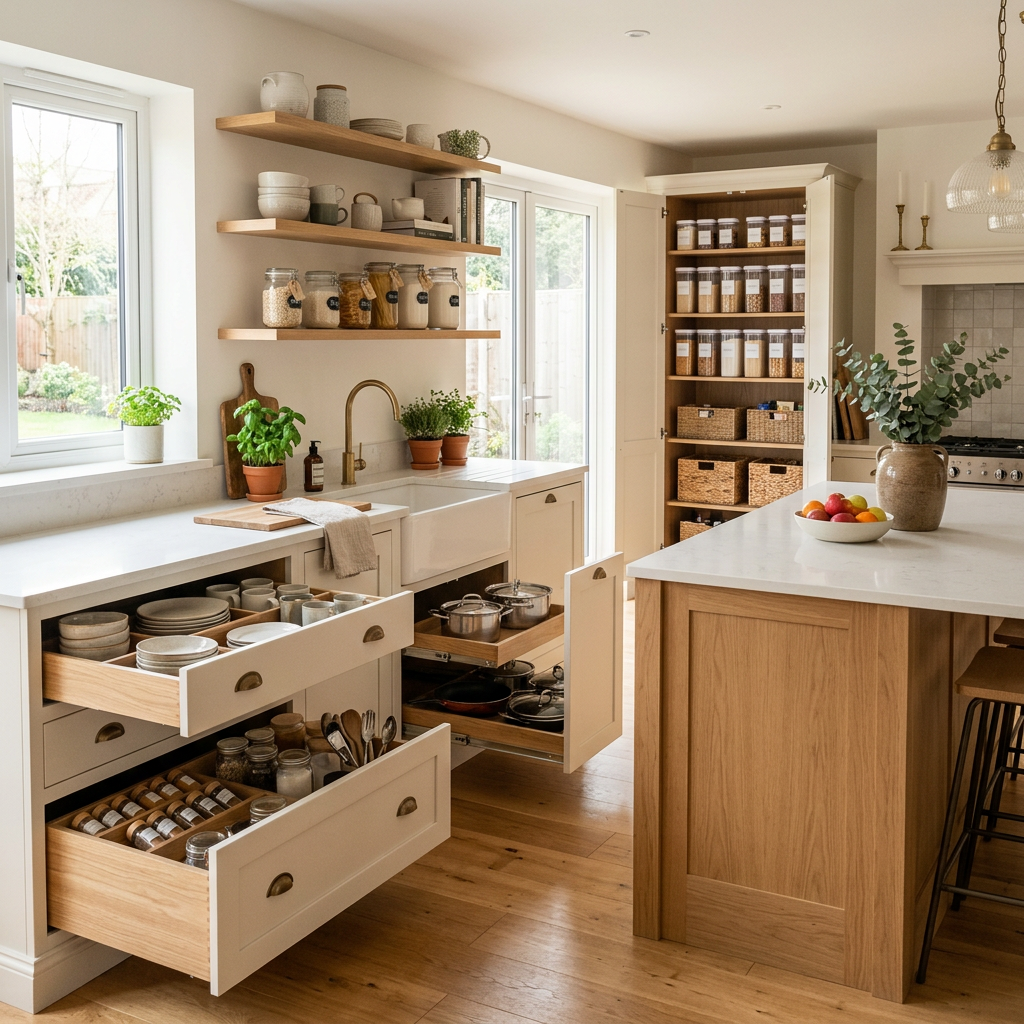
A beautiful kitchen is great, but kitchen storage options that actually work for you are even better.
A thoughtful layout supports daily tasks, encourages smoother workflows, and helps you enjoy cooking rather than navigate clutter.
Good design also considers lighting, reach, and clear zones for prep, cooking, and cleaning.

No matter how large or small your kitchen is, good storage can make the space calm and functional. Consider the right kitchen storage options to keep essentials organized and accessible. When storage fits your routines, you save time and reduce clutter.

The kitchen is one of the hardest-working rooms in the home.
Between cookware, dishes, small appliances, food, cleaning supplies, utensils, and other items, cabinets feel crowded.
Smart organization can free up counter space and make daily cooking smoother.
Exploring kitchen storage options helps optimize layout and access.
The good news is that you don’t necessarily need a larger kitchen to create more storage. Sometimes, you simply need to make better use of the space you already have, exploring kitchen storage options. Small changes can yield notable gains without changing your footprint.
From pull-out drawers and pantry organizers, to vertical storage and multifunctional furniture, many options exist. These options help keep your kitchen organized while preserving style. The key is choosing storage based on how you actually use the space. Consider kitchen storage options to fit your routines.
Start by noting how often you cook, plate, and store bulky items. Then group similar items and assign dedicated zones. Choose fixtures that make those zones easy to reach. Along the way, balance aesthetics and function to maintain style. Reassess periodically as your needs change.
1. Pull-Out Cabinet Drawers
One of the most useful kitchen storage upgrades is the pull-out cabinet drawer. Traditional lower cabinets can create a frustrating problem: things get pushed toward the back, and eventually you forget they’re even there.
Pull-out drawers solve that problem by bringing everything forward.
For example, a lower cabinet could contain a pull-out drawer for pots and pans. Instead of digging through a stack of cookware, you can simply pull the drawer toward you and see everything at once.
Pull-out organizers are also useful for:
- Pots and pans
- Food-storage containers
- Baking supplies
- Cleaning products
- Small appliances
- Spices and oils
These organizers are particularly useful in deep cabinets where the back portion of the cabinet is difficult to access.
Why they’re necessary: Accessible storage prevents wasted space. When you can easily see and reach what you own, you’re more likely to use the space efficiently and less likely to buy duplicates.
2. A Well-Organized Pantry
A pantry can quickly become one of the most chaotic areas in a kitchen. Cereal boxes, canned goods, snacks, pasta, baking supplies, and other foods can easily become mixed together.
A well-organized pantry should have designated zones.
For example, you might keep breakfast foods on one shelf, canned goods on another, baking supplies together, and snacks in baskets or bins.
Clear containers can also make a major difference. Flour, sugar, rice, pasta, and cereal can be transferred into labeled containers so you can immediately see what you have.
You don’t need a huge walk-in pantry either. A small cabinet pantry can work beautifully with adjustable shelves, bins, and tiered organizers.
Why it’s necessary: Pantry organization makes grocery shopping easier, reduces food waste, and helps you quickly locate what you need.
3. Deep Drawers for Pots and Pans
If you’re remodeling or designing a kitchen from scratch, consider replacing some traditional lower cabinets with deep drawers.
Deep drawers are excellent for cookware because pots, pans, lids, and Dutch ovens can be stored in a single accessible location.
You can even add dividers to keep lids upright and prevent cookware from becoming a tangled pile.
For example, one drawer could hold everyday pots and pans while another could store baking dishes and casserole dishes.
Why they’re necessary: Deep drawers eliminate the need to reach into dark cabinets and move several items just to find the one you need.
4. Vertical Cabinet Dividers
Not everything in your kitchen needs to be stored horizontally.
Vertical dividers are perfect for items such as cutting boards, baking sheets, serving trays, cooling racks, and large platters.
Instead of stacking these items on top of each other, store them vertically like books on a shelf.
This simple change can make a cabinet significantly easier to use.
Why they’re necessary: Vertical storage takes advantage of unused cabinet height while making large, flat kitchen items much easier to grab.

5. Under-Sink Storage
The cabinet underneath the kitchen sink is often an overlooked storage opportunity.
Because plumbing takes up some of the available space, this cabinet can be difficult to organize. However, a combination of stackable bins, pull-out shelves, and narrow organizers can turn it into a functional cleaning station.
You might use one bin for dishwasher supplies, another for sponges and brushes, and another for trash bags and cleaning products.
A tension rod can even be used to hang spray bottles, freeing up valuable space underneath.
Why it’s necessary: Under-sink cabinets often become cluttered because everything gets thrown into one open space. Dividing the area into categories makes it much easier to maintain.
6. Corner Cabinet Solutions
Kitchen corners can be some of the most difficult spaces to use effectively.
Fortunately, modern storage solutions can turn those awkward corners into useful storage.
Lazy Susans, rotating shelves, swing-out organizers, and specialized corner drawers can make it easier to access everything stored inside.
For example, a Lazy Susan can hold spices, sauces, baking supplies, or small kitchen appliances.
Why they’re necessary: Without an organization system, corner cabinets often contain large amounts of unusable or forgotten space.
7. Drawer Organizers
Every kitchen needs drawer organizers.
Without them, utensils quickly become mixed together, making it difficult to find what you’re looking for.
A basic utensil organizer can separate forks, knives, spoons, and cooking utensils. But you can go further by creating dedicated sections for measuring spoons, peelers, kitchen scissors, can openers, and other frequently used tools.
Expandable drawer organizers are particularly useful because they can be adjusted to fit your specific drawer.
Why they’re necessary: Small items create some of the biggest sources of kitchen clutter. Drawer dividers give everything a designated home.
8. Spice Storage
Spices have a funny way of taking over kitchen cabinets.
You may have dozens of small jars stacked behind one another, making it difficult to find the seasoning you’re looking for.
A spice drawer, tiered shelf, pull-out spice rack, or wall-mounted spice organizer can dramatically improve accessibility.
For example, a shallow drawer near your cooking area could store spices with the labels facing upward.
Why it’s necessary: You use spices frequently while cooking, so they should be stored somewhere visible and easy to reach.
9. Open Shelving
Open shelving can provide both storage and visual interest.
Instead of hiding everything behind cabinet doors, you can use open shelves to display everyday dishes, glasses, cookbooks, serving pieces, or decorative objects.
For example, a couple of wooden shelves above a coffee station could hold mugs, coffee containers, and a few decorative pieces.
The important thing is not to overcrowd the shelves.
Why it’s necessary: Open shelving provides easily accessible storage while giving you an opportunity to incorporate your personality into the kitchen.

10. Over-the-Door Storage
Don’t forget about the backs of cabinet and pantry doors.
Door-mounted organizers can create additional storage without taking up valuable floor or countertop space.
You can use them for:
- Spices
- Wraps and foil
- Cleaning supplies
- Cutting boards
- Snacks
- Small bottles
- Kitchen tools
For example, a narrow organizer attached to the inside of a pantry door can become a convenient home for smaller items that might otherwise disappear on a shelf.
Why it’s necessary: Cabinet and pantry doors are often completely unused surfaces.
11. A Kitchen Island With Storage
If your kitchen has room for an island, consider choosing one that provides storage instead of treating the island solely as a workspace.
An island can include drawers, cabinets, shelves, or even built-in wine or appliance storage.
For example, the side of the island facing the kitchen could contain drawers for utensils and cookware, while the opposite side could provide open shelves for cookbooks or decorative baskets.
Why it’s necessary: A kitchen island can provide valuable storage while also functioning as a workspace, dining area, or gathering place.
12. Appliance Garages
Small appliances can quickly take over your countertops.
Coffee makers, toasters, blenders, air fryers, and mixers are useful, but they can make a kitchen feel visually cluttered when they’re constantly sitting out.
An appliance garage provides a designated space where frequently used appliances can remain accessible while being hidden from view.
For example, a cabinet with a roll-up or lift-up door can house a coffee maker and toaster.
Why it’s necessary: Keeping frequently used appliances accessible without leaving them scattered across the counter helps maintain a cleaner-looking kitchen.
13. Wall-Mounted Storage
Your walls can become valuable storage space when cabinets and drawers are limited.
A wall-mounted rail can hold cooking utensils, while shelves can hold spices, mugs, or frequently used ingredients.
A pegboard can also be customized to hold pots, pans, cutting boards, and other kitchen tools.
This can be particularly helpful in smaller kitchens where every square inch matters.
Why it’s necessary: Wall storage allows you to take advantage of vertical space without sacrificing valuable cabinet or counter space.
14. Rolling Kitchen Carts
A rolling cart is one of the most flexible storage solutions available.
You can move it wherever you need it, making it useful for kitchens that don’t have enough counter space.
A cart could become a coffee station, baking station, beverage station, or additional prep area.
For example, a three-tier cart could hold baking ingredients on the bottom, small appliances in the middle, and frequently used supplies on top.
Why it’s necessary: Rolling storage provides additional capacity without requiring a permanent renovation.

15. Storage Benches and Breakfast Nooks
If your kitchen includes a breakfast nook, don’t overlook the potential underneath the seating.
A built-in bench can include hidden storage beneath the seat.
This space could hold serving dishes, table linens, seasonal kitchen accessories, or small appliances that aren’t used every day.
Why it’s necessary: Hidden storage allows you to use space that would otherwise serve only one purpose.
16. Food-Storage Container Organization
Food-storage containers are another common source of kitchen frustration.
Containers without matching lids tend to pile up, and before long, the cabinet becomes difficult to manage.
A dedicated drawer or cabinet organizer can keep containers nested together while storing lids vertically in a separate section.
Another option is to choose a matching set of containers that stack neatly.
Why it’s necessary: Organized food-storage containers make meal preparation and leftovers easier while preventing cabinets from becoming overcrowded.
17. Trash and Recycling Pull-Outs
Trash cans don’t have to become a visual focal point in your kitchen.
Pull-out trash and recycling bins can be installed inside a cabinet, keeping them conveniently accessible but hidden from view.
Some systems include separate compartments for trash and recycling.
Why they’re necessary: Concealed waste storage can make the kitchen look cleaner and keep the floor area around the trash can less cluttered.
18. A Dedicated Coffee or Beverage Station
If coffee is part of your daily routine, consider creating a dedicated beverage station.
A small section of countertop can hold your coffee maker, mugs, coffee beans, syrups, and other supplies. Cabinets or drawers underneath can store additional items.
You could even use a small cabinet or bar cart if you don’t have room for a permanent station.
Why it’s necessary: Grouping related items together keeps them from spreading throughout the kitchen and creates a convenient morning routine.
The Best Kitchen Storage Is Storage That Fits Your Lifestyle
The goal of kitchen organization isn’t to make your kitchen look like a showroom. It’s to create a space that works for the people who actually live there.
For frequent cooking, prioritize cookware storage, countertop accessibility, and pantry organization. If you have a large family, focus on food storage, dishes, snacks, and easy-to-access everyday items. If you’re working with a small kitchen, concentrate on vertical storage, multifunctional furniture, and making use of overlooked spaces.
And if you’re someone who loves a beautiful kitchen, remember that organization doesn’t have to mean boring.
Baskets, glass containers, labeled bins, beautiful cutting boards, decorative shelves, and coordinated storage pieces can actually become part of the design.
Think in Zones
One of the easiest ways to organize a kitchen is to create zones based on activities.
In the cooking area, pots, pans, utensils, spices, oils, and cutting boards may be included.
In your baking zone, store flour, sugar, measuring cups, baking sheets, and mixing bowls.
Your coffee zone might contain your coffee maker, mugs, coffee beans, and sweeteners.
Your cleaning zone could include dish soap, sponges, dishwasher detergent, trash bags, and cleaning supplies.
When related items are stored near where they’re used, your kitchen becomes easier to navigate and maintain.

Final Thoughts
The best kitchen storage solutions aren’t necessarily the most expensive ones. Often, the biggest improvement comes from simply giving the space you already have a better organization system.
Pull-out drawers can make deep cabinets accessible. Pantry organizers can reduce food clutter. Vertical dividers can reclaim cabinet space. Drawer organizers can keep utensils under control. Wall storage can take advantage of empty surfaces, while kitchen islands and rolling carts can provide additional workspace and storage.
A functional kitchen should make everyday life easier.
When everything has a place, cooking becomes less stressful, cleaning becomes easier, and your kitchen can finally feel like what it was meant to be: a beautiful, hardworking space designed around the way you live.
At Discovering Life, we believe your home should do more than look good—it should support your everyday life.


Leave a Reply